Venezuela
World Rank: #27
916,445 km²





Venezuela: The Massive South American Giant Most People Underestimate
Venezuela ranks as the twenty-seventh largest country in the world with a territory of 916,445 square kilometers (353,841 square miles). This vast South American nation is the continent’s sixth-largest country, yet its true scale remains consistently underappreciated in global consciousness. What’s truly staggering is that Venezuela’s massive expanse could contain France and Germany combined—essentially engulfing Europe’s two most influential economic powerhouses with room to spare.
What makes Venezuela’s geography extraordinary is its remarkable diversity, ranging from the Caribbean coastline and Andean mountains to expansive plains and the Amazon rainforest. This wide array of landscapes has earned Venezuela the nickname “Land of Grace,” first bestowed by Christopher Columbus who was awestruck by the country’s natural beauty upon his arrival in 1498.
Located between approximately 1° and 12° North latitude, Venezuela experiences minimal distortion on standard Mercator projection maps compared to countries at more extreme latitudes. However, the psychological tendency to underestimate South American countries’ dimensions has contributed to widespread misconceptions about Venezuela’s true size and geographic significance.
Watch Venezuela expand its size as we move it away from the equator. We compare it to the USA, Europe, Africa, Greenland, Brazil, Australia, Russia, India, China, etc. You can use this country size comparison interactive map here.
Venezuela’s True Size Will Astonish You: Global Perspective
To truly grasp Venezuela’s dimensions, these direct comparisons with familiar countries and regions provide eye-opening context:

Venezuela vs. Western Europe: Venezuela would completely engulf several major European powers combined
| Comparison | Area (km²) | Size Relative to Venezuela |
|---|---|---|
| Venezuela | 916,445 | 1.0 |
| France and Germany combined | ~901,000 | ~0.98 times Venezuela’s size |
| Pakistan | 881,913 | 0.96 times Venezuela’s size |
| Texas and Iowa combined (US states) | ~910,000 | ~0.99 times Venezuela’s size |
| United Kingdom, Italy, and Norway combined | ~891,000 | ~0.97 times Venezuela’s size |
5 Mind-Blowing Venezuela Size Comparisons You’ve Never Imagined
- Venezuela vs. United States: Venezuela is approximately 1.5 times the size of Texas. If placed over the eastern United States, it would stretch from New York to Georgia and west to Indiana.

- Venezuela vs. Western Europe: Venezuela could contain France, Germany, and Switzerland combined.
- Venezuela vs. Japan: Venezuela is approximately 2.4 times larger than Japan, despite Japan having about 4.5 times Venezuela’s population.

- Venezuela vs. India:

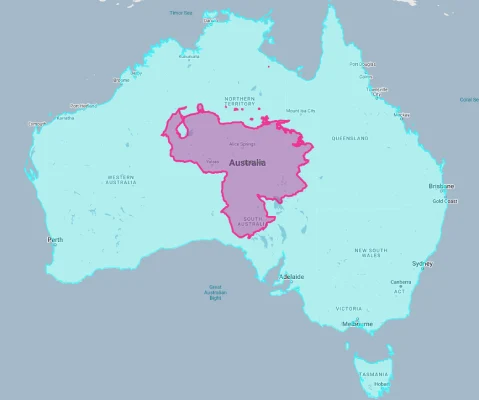
- Venezuela vs. Australia:
Venezuela’s Geographic Diversity: Four Natural Regions
Venezuela’s territory can be divided into four distinct geographical regions:
- The Venezuelan Coastal Range: A mountain chain running parallel to the Caribbean coast that includes the capital city of Caracas and contains the majority of the country’s population
- The Maracaibo Lowlands: A basin surrounding Lake Maracaibo in the northwest, which contains some of the largest oil reserves in the world
- The Llanos (Plains): Vast tropical grasslands that stretch across central Venezuela, covering about one-third of the country and supporting extensive cattle ranching
- The Guiana Highlands: Ancient plateau region in the southeast featuring dramatic tepuis (table-top mountains) and some of the world’s highest waterfalls
- The Orinoco Delta: An extensive river delta at the mouth of the Orinoco River, creating a labyrinth of waterways and islands
Angel Falls and the Tepuis: Nature’s Skyscrapers
The Guiana Highlands region contains some of Venezuela’s most spectacular geographical features:
- Angel Falls (Kerepakupai Merú in the indigenous Pemón language) is the world’s highest uninterrupted waterfall, with a height of 979 meters (3,212 feet) and a plunge of 807 meters (2,648 feet)
- The falls cascade from Auyán-tepui, one of approximately 115 tepuis found in the region
- Tepuis are massive table-top mountains with sheer cliff faces that rise dramatically from the surrounding forests
- These ancient geological formations are effectively “islands in the sky,” isolated for millions of years, resulting in unique ecosystems with high levels of endemic species
- The tepuis and Angel Falls are located within Canaima National Park, a UNESCO World Heritage site covering over 30,000 square kilometers (11,600 square miles)—an area larger than Belgium
Lake Maracaibo: The Lightning Capital of the World
Lake Maracaibo represents one of Venezuela’s most distinctive geographical features:
- This massive body of water covers approximately 13,210 square kilometers (5,100 square miles), making it the largest lake in South America and one of the oldest lakes on Earth (approximately 20-36 million years old)
- Despite its name, Lake Maracaibo is technically not a lake but an inlet of the Caribbean Sea, connected by a narrow strait
- The lake is famous for the “Catatumbo Lightning,” a unique atmospheric phenomenon where lightning occurs almost continuously for 10 hours a night, 140-160 nights per year, generating up to 280 lightning strikes per hour
- This phenomenon, occurring where the Catatumbo River meets the lake, produces the world’s highest concentration of lightning and has been recognized by Guinness World Records as the place with the most lightning strikes per square kilometer per year
- The Maracaibo Basin contains one of the world’s largest oil fields, with extensive oil infrastructure visible across the lake
The Orinoco River: Venezuela’s Lifeline
The Orinoco River forms Venezuela’s most important hydrological feature:
- Stretching 2,140 kilometers (1,330 miles), the Orinoco is South America’s third-longest river and one of the world’s largest by discharge volume
- The river forms a significant portion of the border between Venezuela and Colombia before flowing eastward through Venezuela to empty into the Atlantic Ocean
- The Orinoco Basin covers approximately 880,000 square kilometers (340,000 square miles)—about 80% of Venezuela’s entire territory
- The river’s delta is a vast wetland covering about 40,000 square kilometers (15,400 square miles), containing a labyrinth of channels and islands that support unique ecosystems
- This mighty river supports transportation, fishing, hydroelectric power generation, and irrigation for agriculture
The Venezuelan Andes: Roof of the Nation
The Venezuelan Andes represent the country’s highest mountain region:
- This mountain range is the northeastern extension of the greater Andes chain and covers parts of western Venezuela
- Pico Bolívar, Venezuela’s highest mountain, reaches 4,978 meters (16,332 feet) and is capped by glaciers, though these are rapidly retreating due to climate change
- The region features dramatic landscapes including páramos (high-altitude Andean ecosystems), deep valleys, and the world’s highest cable car system—the Mérida Cable Car, which ascends to 4,765 meters (15,633 feet)
- Unlike the rest of predominantly tropical Venezuela, the Andean region experiences cool temperatures and even occasional snow at higher elevations
- These mountains are geologically young and active, with several fault systems that have produced destructive earthquakes, including the 1812 Caracas earthquake that killed approximately 20,000 people
Population Distribution: Coastal Concentration
Venezuela’s population pattern shows a strong geographic concentration:
- With approximately 28 million people, Venezuela has a moderate average population density of about 31 people per square kilometer
- This density varies dramatically by region, with about 90% of Venezuelans living in the northern 20% of the country, particularly along the Caribbean coast and in the Andean region
- The southern regions, comprising the Llanos and the Guiana Highlands, contain vast areas with fewer than 1 person per square kilometer
- About 88% of Venezuelans live in urban areas, one of the highest urbanization rates in Latin America
- Caracas, the capital and largest city with about 3 million inhabitants (and over 5 million in the metropolitan area), is nestled in a narrow valley within the Coastal Range
Venezuela’s States: Large as European Nations
Many of Venezuela’s 23 states (administrative divisions) are comparable in size to entire countries:
| Venezuelan State | Area (km²) | Comparable Country |
|---|---|---|
| Bolívar | 238,000 | United Kingdom (242,495 km²) |
| Amazonas | 177,617 | Syria (185,180 km²) |
| Apure | 76,500 | Czech Republic (78,865 km²) |
| Zulia | 63,100 | Lithuania (65,300 km²) |
| Guárico | 64,986 | Latvia (64,589 km²) |
Geography and Climate: Tropical with Altitude Variations
Venezuela’s geography creates diverse climatic conditions:
- Located entirely within the tropics, Venezuela’s climate is largely determined by elevation rather than latitude
- Venezuelans traditionally recognize four distinct climate zones based on altitude: the tropical zone (below 800 meters), the temperate zone (800-2,000 meters), the cool zone (2,000-3,000 meters), and the páramo (above 3,000 meters)
- Average temperatures range from 28°C (82°F) in the lowlands to below 8°C (46°F) in the highest mountains
- Most of Venezuela experiences a distinct wet season (May to November) and dry season (December to April), though patterns vary by region
- Annual rainfall varies dramatically, from over 4,000 mm (157 inches) in parts of the Guiana Highlands to less than 500 mm (20 inches) in certain coastal areas
Natural Resources: Petroleum Superpower and Beyond
Venezuela possesses extraordinary natural resource wealth:
- Venezuela has the world’s largest proven oil reserves, estimated at over 300 billion barrels—larger than Saudi Arabia’s
- The country also possesses substantial natural gas reserves, ranking eighth globally
- Venezuela has significant mineral resources, including gold, diamonds, bauxite, iron ore, and coltan
- The nation contains vast water resources, with abundant rivers and lakes that provide substantial hydroelectric potential
- Venezuela’s diverse ecosystems support remarkable biodiversity, with over 21,000 plant species and 1,400 bird species, representing a significant biological resource
Biodiversity: Megadiverse Country
Venezuela’s varied ecosystems support exceptional biodiversity:
- Venezuela is classified as one of the world’s 17 “megadiverse” countries, which together contain about 70% of global biodiversity
- The country is home to approximately 1,400 bird species (13% of the world total), over 350 mammal species, 340 reptile species, and 21,000 plant species
- Venezuela’s ecosystems include cloud forests, páramos, mangroves, tropical rainforests, dry forests, llanos (savannas), tepuis, and coastal reefs
- Endemic species are particularly numerous on the isolated tepuis, which function as ecological islands
- Venezuela has established a system of 43 national parks covering about 16% of the national territory, including Canaima National Park (30,000 km²) and Henri Pittier National Park (Venezuela’s oldest, established in 1937)
Geographic Challenges: Mountains, Rivers, and Development
Venezuela’s geography creates significant development challenges:
- Transportation: Mountainous terrain in the populated north and vast wetlands in the Orinoco Delta create challenges for infrastructure development
- Natural Disasters: Venezuela is vulnerable to earthquakes along its mountain ranges and to devastating landslides, particularly during intense rainfall events
- Flooding: The Orinoco River basin experiences seasonal flooding that can displace communities and damage infrastructure
- Deforestation: Despite substantial protected areas, Venezuela experiences deforestation, particularly in the Amazon region and around population centers
- Climate Change: As a tropical country with extensive coastlines and diverse ecosystems, Venezuela faces significant vulnerability to climate change impacts
Explore More Size Comparisons
Curious about how other major countries and continents compare in true size? Check out these related articles:
- The Unexpected Vastness of Nigeria: African Powerhouse Larger Than Spain, France and United Kingdom Combined
- The Real Size of Pakistan: South Asian Giant Larger Than Turkey and United Kingdom Combined
- The Colossal Truth About Tanzania: East African Giant Larger Than France, Germany and Italy Combined
- Complete List of Countries by True Size
Sources & Further Reading
- Instituto Geográfico de Venezuela Simón Bolívar. (2022). Geographic Information.
- CIA World Factbook. (2023). Venezuela.