Italy
World Rank: #71
301,340 km² (116,350 sq mi)



Next Smaller Country
(Rank #72)
Philippines
300,000 km² (115,831 sq mi)


Italy: The Iconic Boot That’s Smaller Than You Think
Did you know that Italy – that instantly recognizable boot-shaped country – is smaller than 20 U.S. states? Or that you could fit three Italys inside Texas with room to spare?
Welcome to the surprising reality of Italy – a country whose cultural, historical, and culinary influence vastly outweighs its modest physical footprint. Ranking 71st globally with just 301,340 square kilometers (116,350 square miles), Italy is approximately the same size as the Philippines and smaller than countries like Poland and Malaysia that have far less global recognition.
In this article, we’ll drag Italy across the map to reveal how this Mediterranean icon truly measures up against other countries. Located between 36°N and 47°N latitude, Italy experiences minimal map distortion, meaning its representation on standard maps is relatively accurate – it’s genuinely compact!
Despite its modest size, Italy packs extraordinary diversity into its limited space, stretching about 1,185 kilometers (736 miles) from the Alpine peaks in the north to the Mediterranean’s warm waters in the south. Its distinctive boot shape – which extends into the Mediterranean – creates an astonishing 7,600 kilometers (4,720 miles) of coastline, giving Italy the 13th longest coastline in the world despite its relatively small area.
Here is a video with our interactive country comparison tool (adjusts for Mercator projection distortion) that show you how big Italy actually is:
Watch how Italy compares when overlaid on other countries. We’ve moved it across the USA, Australia, Brazil, and many other nations to reveal its true proportions. You can use this country size comparison interactive map here.
7 Jaw-Dropping Italy Size Facts
- Italy is smaller than New Mexico, ranking as only the 71st largest country globally
- Despite its modest size, Italy boasts the 13th longest coastline in the world at 7,600 kilometers (4,720 miles)
- You could fit Italy into Texas three times with room to spare
- Italy is roughly the same size as Arizona and New Mexico combined
- Italy’s land area is 24% smaller than Japan, despite having similar peninsula-and-island geography
- Italy is just 4% larger than the Philippines, despite appearing more significant on world maps
- Italy’s entire territory could fit into the Amazon rainforest 17 times
Italy’s True Size in Global Perspective
To appreciate Italy’s actual dimensions, these direct comparisons with familiar regions offer eye-opening context:

Italy vs. California: Italy is approximately 30% smaller than California (423,970 km²), despite having nearly twice its population
| Comparison | Flag | Area (km²) | Size Relative to Italy |
|---|---|---|---|
| Italy | |
301,340 | 1.0 |
| Philippines | |
300,000 | 0.996 times Italy’s size |
| Poland |  |
312,696 | 1.04 times Italy’s size |
| New Mexico (US state) |  |
314,917 | 1.05 times Italy’s size |
| Finland |  |
338,424 | 1.12 times Italy’s size |
| United Kingdom |  |
242,495 | 0.80 times Italy’s size |
| Ecuador |  |
283,561 | 0.94 times Italy’s size |
5 Astonishing Italy Size Comparisons
- Italy vs. Africa:

- Italy vs. American States: Italy is smaller than 20 U.S. states, including New Mexico, Montana, and Arizona. If placed on the U.S. East Coast, Italy would stretch roughly from New York City to North Carolina – an area Americans often perceive as just part of their country.
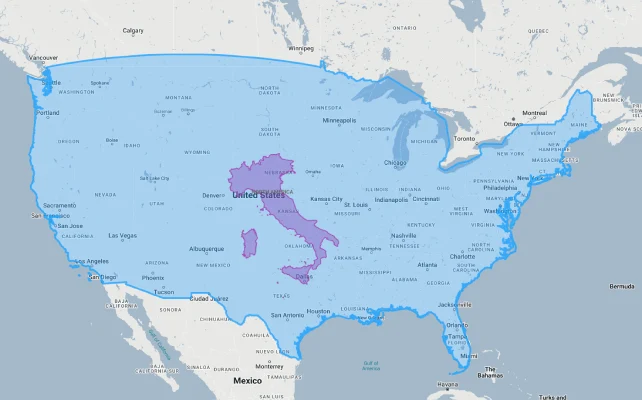
- Italy vs. Philippines: Italy and the Philippines (300,000 km²) are almost identical in size, with Italy being just 1,340 km² larger – an area smaller than Los Angeles. Yet Italy appears much more prominent in global consciousness, demonstrating how cultural influence can magnify perceived size.

- Italy vs. Germany: Italy is 16% smaller than Germany (357,022 km²), despite both being founding EU members with similar global recognition. This size difference is equivalent to the entire nation of Belgium.

- Italy vs. Vietnam: Vietnam (331,212 km²) is approximately 10% larger than Italy, despite being perceived as a smaller country by many Westerners. Vietnam’s long, thin shape compared to Italy’s recognizable boot creates differing perceptions of their relative sizes.

The Italian Size Paradox: Maximum Impact in Minimal Space
Despite its modest territorial footprint, Italy’s global influence vastly exceeds what its size would suggest:
The Cultural Giant Effect
Italy’s extraordinary cultural legacy – the Roman Empire, Renaissance art, and contemporary fashion and design – creates a psychological “size magnification” where historical and cultural importance leads people to perceive Italy as physically larger than it actually is. With more UNESCO World Heritage Sites (58) than any other country, Italy’s cultural footprint far exceeds its geographical one.
The Economic Disproportion
Despite its moderate size, Italy boasts the world’s 8th largest economy by GDP ($2.1 trillion), producing more economic output per square kilometer than much larger nations. This concentration of economic power – nearly 7 times higher per square kilometer than the United States – reinforces perceptions of Italy as more substantial than reality.
The “Boot Shape” Recognition
Italy’s distinctive boot shape makes it one of the most instantly recognizable countries on any world map. This high recognition factor, combined with the peninsula’s prominent position jutting into the Mediterranean, creates an outsized presence in people’s mental geography that exceeds Italy’s actual dimensions.
The Population Density Reality
With approximately 60 million inhabitants packed into its limited territory, Italy maintains a population density of 200 people per square kilometer – more than twice that of France and nearly six times that of the United States. This concentration of humanity creates impressions of a larger country through the scale of its cities and infrastructure.
Italy’s Geographic Diversity: Extraordinary Variation in Limited Space
Italy packs remarkable diversity into its modest territory:
- Alpine Mountains to Mediterranean Islands: Within a straight-line distance of just 1,185 kilometers (736 miles), Italy transitions from Alpine peaks exceeding 4,000 meters (13,123 feet) to sun-drenched Mediterranean islands like Sicily and Sardinia. This makes Italy one of the few countries where you can ski in the morning and swim in the afternoon during certain seasons – an Alpine-to-Mediterranean journey of just 3-4 hours by car in regions like Liguria.
- Volcanic Landscapes: Italy contains the only active volcanoes in mainland Europe, including Mount Vesuvius, Mount Etna (Europe’s tallest active volcano at 3,329 meters/10,922 feet), and Stromboli, which has been erupting continuously for over 2,000 years – earning it the nickname “Lighthouse of the Mediterranean.” These volcanic regions have created some of the world’s most fertile agricultural land.
- Extraordinary Coastline: Despite ranking just 71st in total area, Italy boasts the world’s 13th longest coastline at 7,600 kilometers (4,720 miles) – longer than the coastlines of India, Brazil, and South Africa. This disproportionate coast-to-area ratio is among the highest globally, with 1 kilometer of coastline for every 40 square kilometers of land compared to a world average of 1:152.
- Glacier to Desert: Italy contains both substantial glaciers in the Alps (though shrinking due to climate change) and Europe’s only subtropical desert – the Accona Desert in Tuscany. This arid region, known for its distinctive “Crete Senesi” landscape, receives less than 600mm of rainfall annually and features distinctive barren clay hills (calanchi) that create a lunar-like environment.
- Wildlife Diversity: Italy’s varied landscapes support exceptional biodiversity, with the country hosting approximately 58,000 animal species – about one-third of all European fauna despite occupying less than 5% of Europe’s territory. Italy provides habitat for wolves, brown bears, flamingos, and the critically endangered Mediterranean monk seal within its modest borders.
Italy’s Regions: 20 Distinct Territories
Italy is divided into 20 regions, each with distinctive geography and culture:
| Italian Region | Area (km²) | Comparable To | Major City |
|---|---|---|---|
| Sicily (largest island) |
25,711 | Slightly larger than Macedonia (25,713 km²) | Palermo |
| Piedmont (largest mainland region) |
25,402 | Similar to Rwanda (26,338 km²) | Turin |
| Lombardy (most populous) |
23,844 | Similar to Djibouti (23,200 km²) | Milan |
| Tuscany | 22,987 | Similar to Israel (22,072 km²) | Florence |
| Sardinia (second largest island) |
24,090 | Nearly identical to Macedonia (25,713 km²) | Cagliari |
| Valle d’Aosta (smallest region) |
3,261 | Larger than Luxembourg (2,586 km²) | Aosta |
| Molise (second smallest) |
4,438 | Similar to Trinidad and Tobago (5,130 km²) | Campobasso |
Population Dynamics: Europe’s Densely Packed Peninsula
Italy’s 60 million inhabitants are concentrated in its limited territory:
- With approximately 60 million inhabitants, Italy maintains a high population density of 200 people per square kilometer (518 per square mile) – more than double that of France (119/km²) and nearly six times that of the United States (36/km²).
- Despite this high density, Italy’s population distribution is remarkably uneven, with the Po Valley in northern Italy housing approximately 40% of the country’s population on just 15% of its land. This region, centered around Milan, maintains a population density exceeding 500 people per square kilometer.
- Italy contains an exceptional concentration of historically significant cities, with 49 urban centers that once functioned as capitals of independent states prior to Italian unification in 1861. This includes globally renowned cities like Rome, Venice, Florence, Milan, and Naples.
- Unlike many European countries dominated by a single primate city, Italy maintains a uniquely balanced urban hierarchy. While Rome (2.8 million) is the largest city, Milan (1.4 million), Naples (1 million), Turin (870,000), and Palermo (650,000) serve as powerful regional centers with distinct economic and cultural identities.
- Italy experiences some of Europe’s most dramatic regional demographic disparities, with a rapidly aging and declining population in southern regions contrasted with relatively stable populations in the north. Some rural areas in regions like Basilicata and Molise have lost over 30% of their population since 1990.
Economic Density: Maximum Output in Minimal Space
Italy’s limited territory produces extraordinary economic output:
- Despite its modest size, Italy possesses the world’s 8th largest economy with a GDP of approximately $2.1 trillion – producing more economic output than much larger countries like Brazil, Canada, and Russia.
- Italy generates approximately $7 million in GDP per square kilometer – nearly 7 times higher than the United States ($1.06 million per km²) and over 3 times higher than China ($1.95 million per km²), demonstrating extraordinary economic efficiency relative to its limited territory.
- Despite representing just 0.2% of the world’s land area, Italy produces 3.8% of global luxury goods, 6.2% of global wine output, and contains approximately 6% of all UNESCO World Heritage Sites globally.
- Italy’s manufacturing density is among the world’s highest, with the country ranking as Europe’s second-largest manufacturing power despite its territorial limitations. Italy produces more industrial goods per square kilometer than any G7 country except Japan.
- The country’s tourism sector demonstrates extraordinary spatial efficiency, with Italy hosting approximately 65 million international tourists annually on its limited territory – approximately 216 international visitors per square kilometer compared to France’s 131 and Spain’s 174.
Natural Challenges: Geographic Vulnerabilities
Italy’s compact geography creates specific challenges:
- Seismic Vulnerability: Italy sits at the convergence of the African and Eurasian tectonic plates, making it Europe’s most seismically active country. Approximately 44% of Italy’s territory and 36% of its municipalities fall within high seismic risk zones, including major cities like Naples, Catania, and Messina, where devastating earthquakes have occurred throughout history.
- Volcanic Presence: Italy contains the only active volcanoes in mainland Europe, including Vesuvius, which threatens Naples (the most densely populated volcanic region in the world with 3 million people living in its vicinity), Etna (Europe’s most active volcano with over 200 eruptions in recorded history), and the Phlegraean Fields – a supervolcano showing increasing activity near Naples.
- Hydrogeological Instability: Approximately 91% of Italian municipalities face significant landslide or flood risks, with the country’s steep topography, Mediterranean climate patterns, and extensive coastal development creating particular vulnerabilities. Over 7,000 landslides occur annually across the Italian territory.
- Coastal Erosion: With 7,600 kilometers of coastline, Italy faces substantial erosion challenges, with approximately 42% of its sandy shorelines currently eroding. This threatens both ecosystems and the tourism industry, which relies heavily on Italy’s beaches and coastal communities.
- Alpine Glacier Retreat: Climate change is rapidly shrinking Italy’s Alpine glaciers, which have lost over 30% of their volume since 1980. Beyond the ecological impact, this threatens water resources for northern Italy’s agricultural and industrial centers, which rely heavily on Alpine runoff for irrigation and hydroelectric power.
Global Footprint: Outsized Influence from Limited Territory
Italy’s impact extends far beyond its modest borders:
- Cultural Powerhouse: Italy contains more UNESCO World Heritage Sites (58) than any other nation on Earth – representing over 5% of all such sites globally despite occupying just 0.2% of the world’s land area. This extraordinary density of cultural treasures (1 UNESCO site per 5,195 km²) is 25 times the global average.
- Linguistic Reach: The Italian language is spoken by approximately 67 million native speakers globally and serves as a major language of culture, music, design, and cuisine. Italian words permeate global vocabularies, with an estimated 300+ Italian words commonly used in English – particularly in fields like music, art, food, and architecture.
- Culinary Dominance: Despite its limited agricultural territory (approximately 16.7 million hectares), Italian cuisine has achieved unparalleled global influence. Italian restaurants are the most common ethnic food establishments worldwide, with pizza alone generating approximately $145 billion in global sales annually – a culinary empire built from a modest territorial base.
- Diaspora Impact: Due to historical emigration patterns, approximately 80 million people of Italian descent live outside Italy’s borders – creating a global Italian community 33% larger than the population of Italy itself. Major Italian diasporas exist in the United States (17 million), Brazil (31 million), Argentina (25 million), and Australia (1 million).
- Design Influence: From a territorial base smaller than New Mexico, Italy has developed extraordinary global influence in design, fashion, and luxury goods. Despite representing just 0.2% of the world’s land area, Italy produces approximately 40% of global luxury fashion, with Milan-based fashion houses alone generating over €70 billion in annual revenue.
Explore More Size Comparisons
Curious about how other major countries and regions compare in true size? Check out these related articles:
- The True Size of Germany: Central European Power’s Real Dimensions
- The Real Size of France: Western European Nation Larger Than You Think
- The True Size of Spain: Iberian Peninsula’s Actual Proportions
- Complete List of Countries by True Size
Sources & Further Reading
- Italian National Institute of Statistics (ISTAT). (2024). Geographical Information and National Statistics.
- Italian Geographical Society. (2023). Physical Geography of Italy.
- Ministry of Environment and Land Protection. (2024). Italian Territorial Data.
- CIA World Factbook. (2024). Italy.