World Rank: #125
56,594 km² (21,851 sq mi)



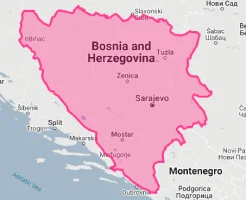
Croatia: The Crescent-Shaped Jewel with a Thousand Islands
Did you know Croatia, smaller than West Virginia, contains more islands than days in a year? This remarkable Adriatic nation packs an astounding 1,244 islands, islets, and reefs into a territory of just 56,594 square kilometers (21,851 square miles).
Like many countries far from the equator, Croatia suffers from significant distortion on standard world maps. The commonly used Mercator projection drastically misrepresents Croatia’s true size, making countries near the poles appear much larger than they really are compared to equatorial nations.
When viewed on a typical Mercator map, Croatia can appear similar in size to much larger nations. In reality, this Mediterranean gem could fit into Algeria 43 times or Russia 302 times! Our interactive tool corrects this distortion by letting you drag Croatia across the map to see its true size compared to other countries:
Watch Croatia’s true size revealed! See how this Adriatic nation compares when dragged across Russia, North America, and Africa using our interactive mapping tool that corrects for Mercator distortion.
7 Surprising Croatia Size Facts
- Croatia is 302 times smaller than Russia yet has a longer coastline than many countries twice its size
- With just 56,594 km², Croatia is smaller than West Virginia (62,259 km²) yet contains 1,244 islands
- Croatia would fit into the continental United States 169 times, yet has more UNESCO World Heritage Sites than 32 U.S. states combined
- Despite its small size, Croatia has a 1,777 km (1,104 mi) coastline – longer than countries like India, Egypt, and South Africa
- You could fit 12 Croatias inside its neighbor Italy, yet Croatia has more islands
- Croatia is 43 times smaller than Algeria but receives 37 times more tourists annually
- You can drive across Croatia’s entire width in just 3 hours (412 km/256 mi), making it possible to ski in the mountains and swim in the sea on the same day
Croatia Among Its Adriatic Neighbors
Croatia sits in a unique position among the countries of the former Yugoslavia and the Adriatic region:
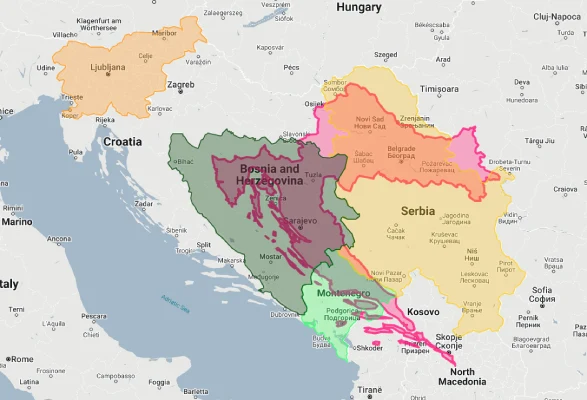
Croatia (highlighted in red) compared to countries of the former Yugoslavia. Despite occupying just 22% of ex-Yugoslavia’s territory, Croatia claims 75% of its coastline!
Size Twins: Countries and States Similar to Croatia
| Size Comparison | Flag | Area (km²) | How It Compares to Croatia |
|---|---|---|---|
| Croatia | |
56,594 | Our Adriatic baseline |
| Bosnia and Herzegovina | 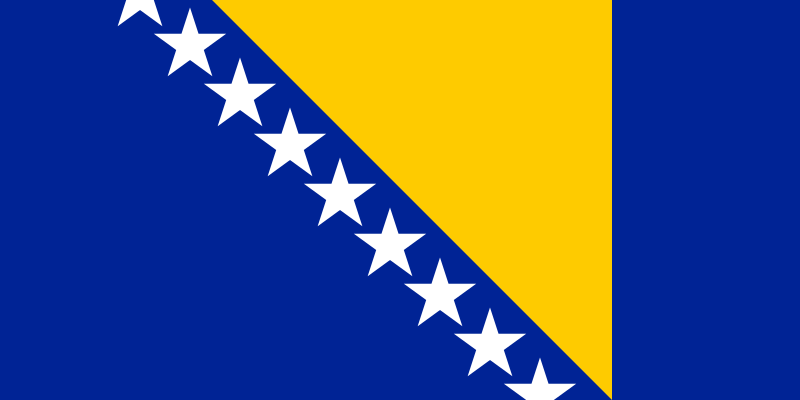 |
51,197 | 10% smaller than Croatia but almost completely surrounded by it |
| Costa Rica | 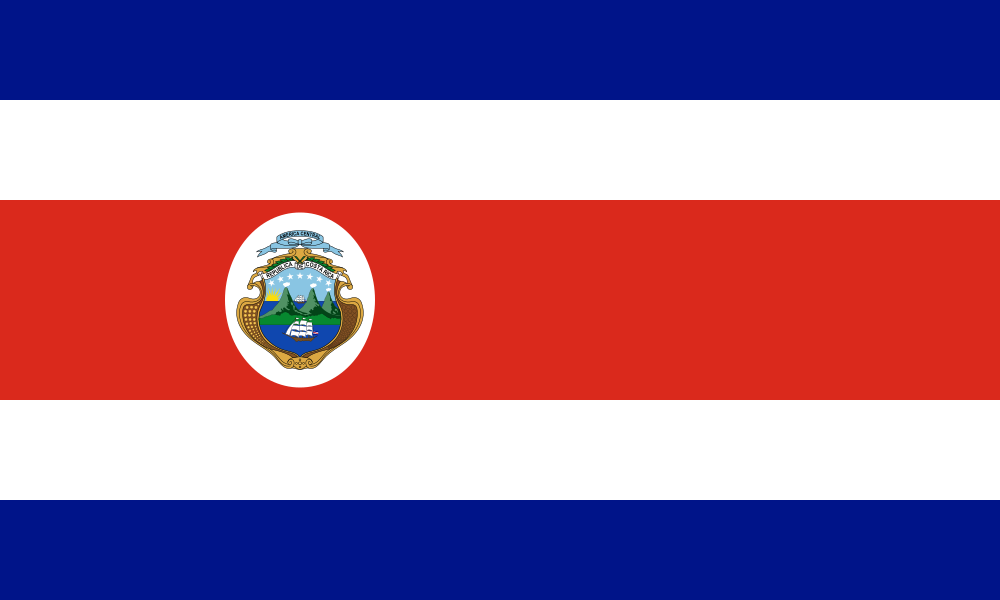 |
51,100 | 10% smaller with similar tourism-driven economy and biodiversity |
| West Virginia (US state) |  |
62,259 | 10% larger than Croatia with similar mountainous terrain |
| Denmark |  |
43,094 | 24% smaller despite being considered a larger European country |
| Latvia |  |
64,589 | 14% larger than Croatia with similar population size |
| Lake Michigan (Great Lake) | |
58,030 | This single lake is 3% larger than the entire country of Croatia |
Croatia vs. Russia: A Mediterranean Minnow Against the Global Giant
Croatia would fit into Russia an astounding 302 times! This extreme contrast shows how severely Mercator projection distorts our perception of size.
When overlaid on Russia’s vast territory, Croatia is barely visible – about the size of a small Russian oblast or republic. Russia’s Krasnoyarsk Krai region alone could contain 41 Croatias.
Despite this overwhelming size difference, Croatia receives more international tourists annually (21 million vs. 19 million pre-pandemic) and has a higher GDP per capita than the world’s largest country.
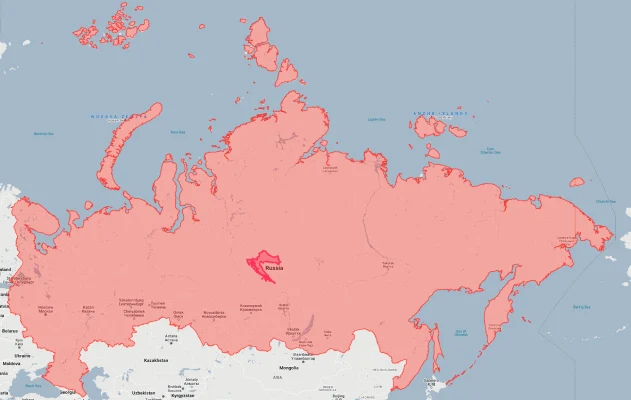
Croatia (highlighted in red) would fit into Russia 302 times! This dramatic comparison shows the severe size distortion in standard Mercator maps.
Croatia vs. United States: The Adriatic Dot in America
Croatia would fit into the continental United States approximately 169 times. It’s smaller than 49 of the 50 U.S. states, with only Rhode Island being smaller.
If placed over the eastern United States, Croatia would barely cover the distance from Baltimore to New York City – yet this modest territory contains 1,244 islands and 10 UNESCO World Heritage Sites.
Most impressively, Croatia’s coastline (1,777 km) exceeds that of the entire U.S. West Coast from Washington to California (1,360 km).
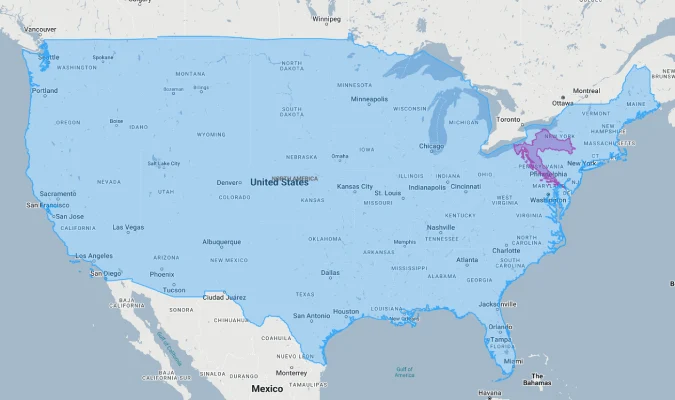
Croatia overlaid on the eastern United States – it would barely cover the distance from Baltimore to New York City.
Croatia’s Unique Shape and Coastline
Croatia’s territory is defined by its unusual crescent shape and remarkable coastline:
- The Crescent Nation: Croatia’s distinctive C-shaped territory wraps around neighboring Bosnia and Herzegovina, creating one of Europe’s most recognizable country outlines. This unusual configuration gives Croatia a maximum north-south distance of just 350 kilometers (217 miles) but an extraordinary east-west span of 412 kilometers (256 miles).
- The Coastal Giant: Despite being one of Europe’s smaller nations, Croatia possesses the third-longest coastline in the Mediterranean at 1,777 kilometers (1,104 miles), behind only Greece and Italy. When measured against its total land area, Croatia has the most coastline per square kilometer of any mainland European country.
- The Island Universe: Croatia contains 1,244 islands, islets, and reefs – more than a day for every year. Only 47 islands are permanently inhabited, with the largest being Krk and Cres (each 405.78 km²). Croatia’s islands alone cover 3,259 km² – about 5.8% of the national territory.
- The Narrowest Country: At its thinnest point near the town of Neum in Bosnia and Herzegovina, Croatia narrows to just 7.5 kilometers (4.7 miles) wide, creating one of Europe’s most striking territorial bottlenecks. This “wasp waist” creates a situation where you can stand in Croatia and see both Bosnia and the Adriatic Sea simultaneously.
Croatia’s Five Regions in a Small Package
Despite its compact size, Croatia contains five distinct geographical regions:
| Croatian Region | Area (km²) | Similar Size To | Geographic Character |
|---|---|---|---|
| Dalmatia | ~12,100 | Qatar | The famous southern coastal region with most of Croatia’s islands and ancient Roman ruins |
| Istria | ~3,500 | Rhode Island | Heart-shaped peninsula with Italian influences, truffles, and olive groves |
| Slavonia | ~12,500 | Lebanon | Eastern agricultural plains along the Danube with rich farmland and wetlands |
| Central Croatia | ~19,400 | Israel | The Zagreb region with rolling hills, medieval castles, and the capital city |
| Mountainous Croatia | ~9,100 | Cyprus | Karst highlands with Plitvice Lakes, caves, and peaks up to 1,831 meters |
5 Natural Wonders Packed into Croatia’s Small Territory
1. The Dalmatian Coast
Croatia’s most famous feature is its stunning Dalmatian coastline, where crystal-clear turquoise waters meet white limestone shores beneath towering mountain backdrops.
This dramatic coast includes the famous walled city of Dubrovnik, 1,246 islands and reefs, and some of Europe’s clearest waters, with visibility often exceeding 50 meters.
2. Plitvice Lakes National Park
In Croatia’s mountainous interior lies one of Europe’s most spectacular water features – 16 terraced lakes connected by 90+ waterfalls cascading through forest-lined canyons.
This UNESCO World Heritage site features distinctive travertine barriers that naturally form and grow about 1cm per year, constantly reshaping this living water system.
3. Kornati Archipelago
Sometimes called “nautical paradise,” this dense cluster of 89 islands and islets contains almost no permanent settlements, creating one of the Mediterranean’s most pristine island ecosystems.
The islands feature dramatic cliffs up to 82 meters high plunging directly into the sea – called “crowns” by locals – some of the most vertical coastal features in Europe.
4. Dinaric Karst
Croatia contains some of Europe’s most dramatic karst (limestone) topography, with thousands of sinkholes, caves, and disappearing rivers creating a Swiss-cheese landscape.
This includes Červeno jezero (Red Lake), a massive sinkhole with near-vertical walls extending 528 meters from rim to the lake floor – one of the world’s largest known sinkholes.
5. Kopački Rit Wetlands
At Croatia’s eastern border, where the Danube and Drava rivers meet, lies one of Europe’s largest remaining wetlands – a 177 km² floodplain forest and marsh ecosystem.
This “European Amazon” hosts 293 bird species (80% of all European birds), 55 mammal species, and 44 fish species, creating one of continental Europe’s richest wildlife habitats.
Explore More Size Comparisons
Curious about how other countries compare in true size? Check out these related articles:
- Real Size Of Slovenia: The Alpine Gem Smaller Than New Jersey Yet With Mountains, Caves, and Coastline
- Real Size Of Bosnia and Herzegovina: The Heart-Shaped Balkan Nation Smaller Than West Virginia
- Real Size Of Greece: Small Mediterranean Nation With More Coastline Than France and Spain Combined
- Real Size Of Italy: Mediterranean Peninsula Smaller Than New Mexico Yet Home to 60% of Europe’s Art Treasures
- Complete List of Countries by True Size